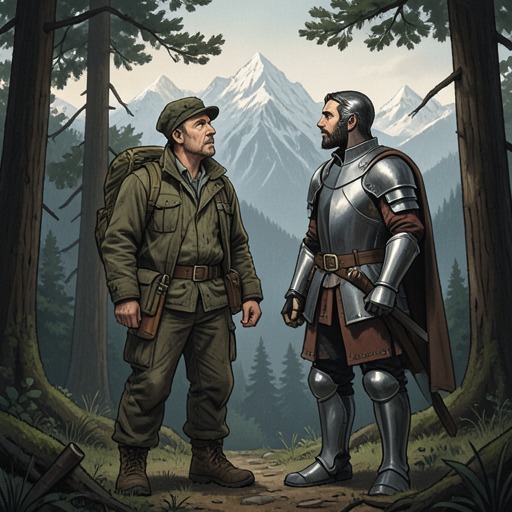
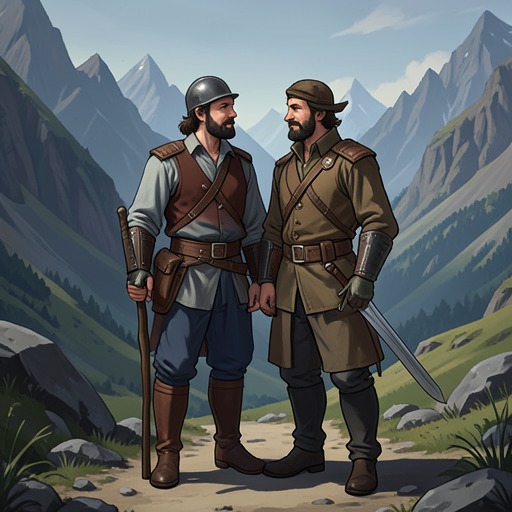
The Blizzard Night near the Seven Rocks
De brief voor de KoningThe Blizzard Night near the Seven Rocks turns Tiuri and Piak’s mountain crossing into a test of endurance, judgment, and mutual aid. A day that begins with glimpses of sun ends in darkness, falling snow, and a perilous retreat; the two reach only a shallow cave, where they must keep moving and keep one another awake through the night. The storm delays their route toward Unauwen, but it also becomes part of the trial Tiuri later recognizes as having changed him.
The Crossing and Its Demands
The day’s timetable is set by the mountain itself. As they continue, Piak estimates that it is around three o’clock, with roughly an hour to the glacier and another hour to cross it. They need to pass the Seven Rocks before dark so they can reach the pass the following morning and see Unauwen before midday. Although Tiuri would have preferred a longer rest, he follows Piak’s lead, understanding that the guide has good reason to press on.
The route grows rougher as they climb out of a ravine. No path remains visible, yet Piak walks without hesitation and moves faster wherever the ground allows. At the glacier, he loosens and carefully coils the rope before leading Tiuri over the ice. The surface is not a solid, simple expanse: narrow, fast-running streams and treacherous cracks cut across it, and Piak notices that there seem to be more cracks than when he last came through. He chooses a course Tiuri cannot discern, making the crossing depend on Piak’s experience as well as their care.
The glacier takes longer than expected. At about its midpoint, they meet a stream too wide to jump, running through a deep channel with smooth sides. They have to follow it until they find a place to cross, then retrace part of the way to regain the safer route across the ice. By the time they leave the glacier, they are thoroughly cold and have spent much longer on it than the planned hour. The delay matters: Piak is trying to get beyond the Seven Rocks before darkness, and the weather is turning against them.
Snowfall on the Ridge
Piak studies the sky and fears snow. His warning proves right. Darkness comes alarmingly quickly; then the first flakes fall, the wind strengthens, and blowing snow makes it hard to see. The wind is mostly at their backs, a small advantage against conditions that otherwise worsen both visibility and footing. The slippery terrain is harder to cross than it was in daylight, and their intended progress is no longer safe to assume.
They are on a narrow ledge, with high rock walls to their right and a ravine to their left. Piak identifies their position as below the fourth rock, but the number offers no reassurance: the ledge ahead grows narrower and steeper, and the light is nearly gone. Tiuri is shivering so badly that his hands and feet have lost feeling. His arm, which began hurting on the glacier, grows more painful with every step, but he says nothing and continues to struggle onward.
At last Piak stops. Continuing, he judges, would be dangerous. Staying on the exposed ledge is no answer either: it is too cold and offers no shelter. He knows of a shallow cave near the beginning of the third rock, just far enough behind them to offer protection from the wind. The decision reverses their direction at the moment when they had been trying to gain ground. Survival now depends on retreating carefully rather than forcing progress.
The Retreat and the Shelter
The descent proves harder than the climb. They now face the wind, and the snow nearly blinds them. They move slowly because hurrying would be dangerous; they take turns leading and often stop to help each other. In the near-darkness the landscape is difficult to read, and when Piak asks whether Tiuri recognizes a place, Tiuri can barely see anything and says that everything looks alike.
The cold and exertion are wearing Tiuri down. He thinks he cannot endure much longer and may simply fall, but the two continue searching for the third rock. When Piak finally calls that they have reached it—almost, at least—the cave is found just in time. It is so shallow that they can only sit side by side inside it. It blocks the wind, not the cold. They open their travel packs and wrap themselves in their blankets, having secured shelter without finding comfort.
Piak warns that they must not sleep: they would become too cold. Instead, they need to move from time to time, stamp their feet, and keep their bodies active. The refuge is therefore not a release from the ordeal but a different way of enduring it. The mountain has forced them to stop, and even rest has to be managed as a survival task.
Keeping the Night
Wind howls around the rock walls, and distant rumbling might be thunder or falling stones. The two eat what they have and huddle close together, fighting sleep. At intervals they carefully walk back and forth on the narrow ledge outside the cave, but the cold soon drives them back under its limited protection. They sit upright, stamp their feet, or rub each other’s hands to keep warm.
Conversation helps occupy the long hours. Tiuri recounts his adventures in the forest and at Castle Mistrinaut, then speaks of Castle Tehuri, the City of Dagonaut, and the king’s knights, naming them and describing their shields and heraldic devices. Piak, in turn, tells of his birthplace, the mountains, and the hermit, and sings the songs he knows. Their talking eventually becomes tiring; long silences follow, and sleep repeatedly threatens to overtake them. When one dozes, the other wakes and shakes him. Their companionship is practical as well as personal: each helps keep the other conscious and moving.
The storm does not break all at once. During the night the wind slowly eases, the snow stops, and at last the pale light of dawn appears. They nibble hard bread rather than the hot bean soup Piak would like, and prepare to continue. The arrival of daylight marks an end to the night’s immediate danger, not the end of their journey.
A Trial on the Road to Knighthood
The night’s struggle echoes the formal vigil required of young men before they are knighted in Dagonaut. That ritual calls for a night awake in a small chapel, with swords laid before the altar; the candidates must fast, pray, and reflect on their duty. Tiuri and Piak’s night in the mountains is not that ceremony: there is no altar or formal promise, and their immediate concern is staying warm and alive. Yet its enforced wakefulness, physical hardship, and shared vigilance give the episode a striking parallel to the discipline expected of a knight.
Much later, after completing his mission and fulfilling his promise to Edwinem, Tiuri hears Dagonaut say that he has shown himself to be a knight even before receiving the accolade. In the chapel that night, Tiuri reflects that everything he has endured can be regarded as a trial. He looks back on the people he has met and the friends he has made, and recognizes that the Tiuri keeping vigil now is different from the boy who began the night in the chapel many days earlier. The blizzard is one episode within that larger passage: its decisive measure is not that Tiuri conquers the mountains, but that he endures danger alongside Piak and later understands the journey as preparation for the responsibilities of knighthood.